 简体中文
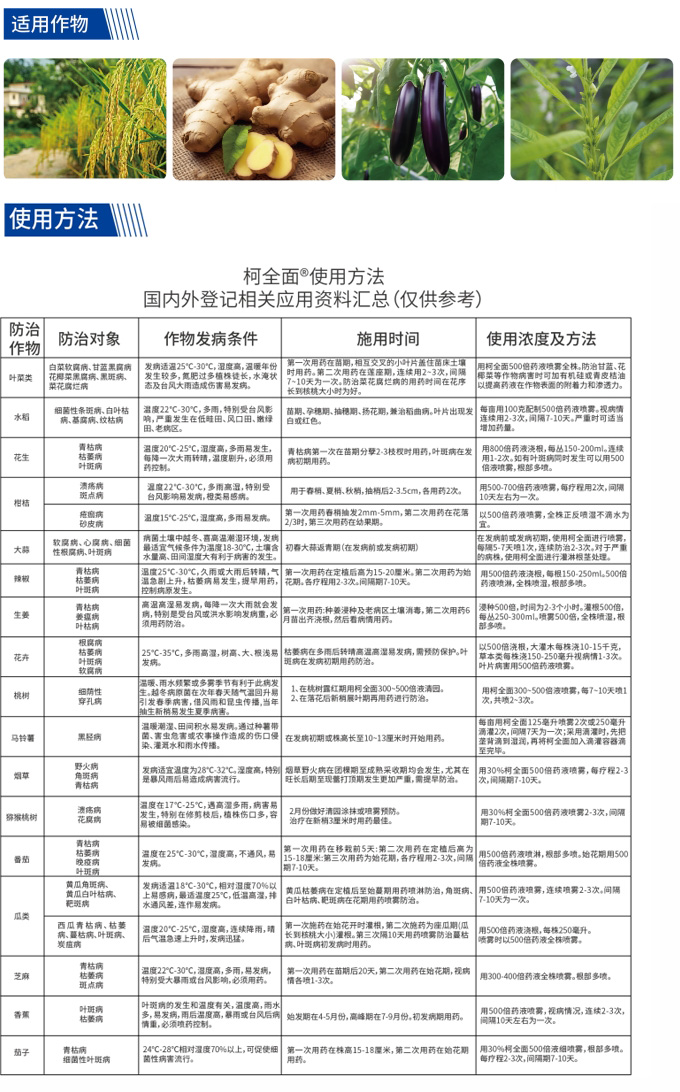
简体中文Application Method of Kequanmian®
Summary of Relevant Registered Application Data at Home and Abroad (For Reference Only)
| Crops to be Controlled | Target Diseases | Disease Occurrence Conditions | Application Time | Application Concentration and Method |
| Leafy Vegetables | Chinese cabbage soft rot, Cabbage black rot, Cauliflower black rot, Alternaria leaf spot, Cauliflower rot | Optimal temperature for disease occurrence is 25℃-30℃ with high humidity; more prevalent in warm years. Excessive nitrogen fertilizer causes excessive plant growth, and waterlogging or damage from typhoons and heavy rains easily induce the disease. | First application at seedling stage when the intercrossed small leaves cover the seedbed soil. Second application at rosette stage, apply continuously for 2~3 times with an interval of 7~10 days each time. The optimal time to control cauliflower rot is when the inflorescence grows to the size of a walnut. | Spray the whole plant with Kequanmian 500 times dilution. When controlling diseases on cabbage, cauliflower and other crops, add organosilicon or green orange oil to improve the adhesion and penetration of the liquid medicine on the crop surface. |
| Rice | Bacterial leaf streak, Bacterial blight, Bacterial foot rot, Sheath blight | Temperature 22℃-30℃ with frequent rainfall, especially affected by typhoons; severe occurrence in low-lying fields, windward fields, tender green fields and old disease areas. | Seedling stage, booting stage, heading stage, anthesis stage (also controls rice false smut). When leaves turn white or red. | Use 100 grams per Mu to prepare 500 times dilution for spraying. Apply continuously for 2-3 times with an interval of 7-10 days depending on the disease severity. Increase the dosage appropriately in severe cases. |
| Peanut | Bacterial wilt, Fusarium wilt, Leaf spot | Temperature 20℃-25℃ with high humidity and frequent rainfall; disease easily occurs. After each heavy rain followed by sunny weather and sharp temperature rise, chemical control is necessary. | First application for bacterial wilt at seedling stage when 2-3 branches tiller; apply for leaf spot at the initial stage of disease occurrence. | Irrigate roots with 800 times dilution, 150-200ml per clump. Apply continuously for 1-2 times. If leaf spot occurs simultaneously, spray with 500 times dilution and spray more on the roots. |
| Citrus | Bacterial canker, Alternaria leaf spot | Temperature 22℃-30℃ with frequent rainfall and high humidity, especially susceptible to typhoons; orange varieties are highly susceptible. | Apply for spring shoots, summer shoots and autumn shoots when shoots grow to 2-3.5cm, 2 applications for each shoot stage. | Spray with 500-700 times dilution, 2 applications per course of treatment with an interval of about 10 days each time. |
| Scab, Greasy spot | Temperature 15℃-25℃ with high humidity and frequent rainfall; disease easily occurs. | First application when spring shoots grow to 2mm-5mm, second application when 2/3 of flowers fall, third application at young fruit stage. | Spray with 500 times dilution, wet the whole plant (both sides) until no dripping is appropriate. | |
| Garlic | Soft rot, Heart rot, Bacterial root rot, Leaf spot | Pathogens overwinter in soil and favor high temperature and humid environment; the optimal climatic conditions for disease occurrence are temperature 18-30℃, high soil moisture and field humidity which are conducive to disease occurrence. | Regreening stage of garlic in early spring (before or at the initial stage of disease occurrence) | Spray with Kequanmian before or at the initial stage of disease occurrence, once every 5-7 days for 2-3 consecutive treatments. For severely infected plants, irrigate and drench the rhizome with Kequanmian. |
| Chili Pepper | Bacterial wilt, Fusarium wilt, Leaf spot | Temperature 25℃-30℃; fusarium wilt easily occurs after prolonged rain or heavy rain followed by sunny weather with sharp temperature rise; early application is required to control pathogen occurrence. | First application at 15-20 cm height after transplanting. Second application at initial flowering stage. 2-3 applications per course of treatment with an interval of 7-10 days. | Irrigate roots with 500 times dilution, 150-250ml per plant. Drench with 500 times dilution, wet the whole plant and spray more on the roots. |
| Ginger | Bacterial wilt, Bacterial wilt of ginger, Leaf blight | High temperature and humidity easily induce the disease; disease occurs after each heavy rain, especially severe after typhoons or floods; chemical control is necessary. | First application: soak seed ginger and disinfect soil in old disease areas; second application: irrigate roots when seedlings are fully emerged in June, then apply according to disease severity. | Soak seeds with 500 times dilution for 2-3 hours. Irrigate roots with 500 times dilution, 250-300ml per clump. Spray with 500 times dilution, wet the whole plant and spray more on the roots. |
| Flowers | Root rot, Fusarium wilt, Leaf spot, Soft rot | Temperature 25℃-35℃ with frequent rainfall and high humidity; tall and large trees with shallow roots are susceptible to the disease. | Fusarium wilt easily occurs after rainy days followed by sunny weather with high temperature and humidity, requiring preventive protection. Apply for leaf spot at the initial stage of disease occurrence. | Irrigate roots with 500 times dilution: 10-15 kg per large shrub, 150-250 ml per herbaceous plant, 1-3 times depending on disease severity. For leaf diseases, spray with 500 times dilution. |
| Peach Tree | Bacterial shot hole | Warm seasons with frequent rainfall or heavy fog are conducive to disease occurrence. Overwintering pathogens easily cause spring diseases with temperature rise in the next year, spread by wind, rain and insects; new shoots sprouted in the current year are susceptible to summer diseases. | 1. Clean the orchard with Kequanmian 300~500 times dilution at peach bud swelling stage. 2. Apply again to control the disease at new shoot leaf expansion stage after flowering. | Spray with Kequanmian 300~500 times dilution, once every 7~10 days for a total of 2~3 times. |
| Potato | Black leg | Warm and humid conditions with field waterlogging easily induce the disease. Infected through seed potatoes, wounds caused by pest damage or agricultural operations, spread by irrigation water and rainwater. | Start application at the initial stage of disease occurrence or when plants grow to 10~13 cm in height. | Use 125 ml of Kequanmian per Mu for spraying twice or 250 ml for drip irrigation twice with an interval of 7 days each time; for drip irrigation, first wet the ridge back, then add Kequanmian to the drip irrigation container until completion. |
| Tobacco | Wildfire, Angular leaf spot, Bacterial wilt | Optimal temperature for disease occurrence is 28℃-32℃. High humidity, especially after rainstorms, easily causes disease epidemic. | Tobacco wildfire occurs from rosette stage to mature harvest stage, especially severe from late vigorous growth stage to budding and topping stage, requiring early control. | Spray with 30% Kequanmian 500 times dilution, 2-3 times per course of treatment with an interval of 7-10 days. |
| Kiwi Tree | Bacterial canker, Blossom blight | Temperature 17℃-25℃ with high humidity and frequent rainfall; disease easily occurs, especially after pruning with many plant wounds which are susceptible to bacterial infection. | Clean the orchard and apply smearing or spraying for prevention in February. The optimal treatment time is when new shoots are 3 cm long. | Spray with 30% Kequanmian 500 times dilution for 2-3 times with an interval of 7-10 days. |
| Tomato | Bacterial wilt, Fusarium wilt, Late blight, Leaf spot | Temperature 25℃-30℃ with high humidity and poor ventilation; disease easily occurs. | First application 5 days before transplanting; second application at 15-18 cm height after transplanting; third application at initial flowering stage. 2-3 applications per course of treatment with an interval of 7-10 days. | Drench with 500 times dilution and spray more on the roots. Spray the whole plant with 500 times dilution at initial flowering stage. |
| Cucurbits | Cucumber angular leaf spot, Cucumber bacterial blight, Target spot | Optimal temperature for disease occurrence is 18℃-30℃, susceptible when relative humidity above 70%, most optimal temperature 25℃; low temperature and high humidity, poor drainage and ventilation, continuous cropping easily induce the disease. | Control cucumber fusarium wilt by drenching from transplanting to initial vine stage; control angular leaf spot, bacterial blight and target spot by spraying at flowering stage. | Spray with 500 times dilution continuously for 2-3 times with an interval of 7-10 days each time. |
| Watermelon bacterial wilt, Fusarium wilt, Gummy stem blight, Leaf spot, Anthracnose | Temperature 20℃-25℃ with high humidity and continuous rainfall; disease spreads rapidly when temperature rises sharply after sunny weather. | First application: irrigate roots at initial flowering stage; second application: irrigate roots at fruit setting stage (when fruits grow to walnut size). Third application: spray after 10 days to control gummy stem blight and leaf spot at initial occurrence. | Irrigate roots with 500 times dilution, 250 ml per plant. Spray the whole plant with 500 times dilution for foliar application. | |
| Sesame | Bacterial wilt, Fusarium wilt, Alternaria leaf spot | Temperature 22℃-30℃ with high humidity and frequent rainfall; disease easily occurs, especially affected by heavy rain or typhoons; chemical control is necessary. | First application 20 days after seedling stage, second application at initial flowering stage; spray 1-3 times each depending on disease severity. | Spray the whole plant with 300-400 times dilution and spray more on the roots. |
| Banana | Leaf spot, Fusarium wilt | Leaf spot occurrence is related to temperature; high temperature and frequent rainfall easily induce the disease; disease severity increases after rainy days with high temperature, rainstorms or typhoons; spraying is necessary to control the disease. | Initial occurrence period in April-May, peak period in July-September. Apply at initial disease stage. | Spray with 500 times dilution, 2-3 consecutive times depending on disease severity with an interval of about 10 days each time. |
| Eggplant | Bacterial wilt, Bacterial leaf spot | Relative humidity above 70% at 24℃-28℃ can promote the epidemic of bacterial diseases. | First application at 15-18 cm plant height, second application at initial flowering stage. | Fine spray with 30% Kequanmian 500 times dilution and spray more on the roots. 2-3 applications per course of treatment with an interval of 7-10 days. |
Chinese Invented Patent Product: Exclusive patented ingredient, the only registered certificate nationwide.
Dual Control of Fungi & Bacteria: Thiazole group + copper ions + tebuconazole, with special efficacy against bacteria and high efficiency against fungi.
Low-Toxicity Fungicide: Adopting a special synergistic processing technology, it converts low-toxicity raw materials into low-toxicity products, enabling wider application scenarios.
Copper Supplementation & Green Enhancement: Promotes chlorophyll synthesis and photosynthesis, making leaf color bright and glossy, and increasing yield.
Shentai Solution with Kequanmian®
Kapa®/Taizan® + Kequanmian® – Rapidly controls fungi & bacteria, supplements copper and enhances leaf greenness!
Kequanmian® + Aoxi®/Metalaxyl-M + Shentai Duoxi® – Comprehensive prevention and control of seedling death & stem rot (root diseases such as root rot and soft rot)!
Yield Increase Solution for Rice, Wheat, Corn, Peanut + Kequanmian® – Comprehensive prevention and control of fungi & bacteria, preventing diseases and increasing yield!
Nongxiu®, Nongcui®, Mixiante® (Fosthiazate) + Kequanmian® – Comprehensive prevention and control of underground nematodes and underground diseases!
Downy Mildew & Phytophthora Fungicide + Kequanmian® – Comprehensive prevention and control of downy mildew, phytophthora and bacterial diseases, with multiple efficacy guarantees!